Africa Is Not One Market, But It Is One Strategic Opportunity
Gabriel Ajala
February 23, 2026
How Pan-African Sports Investment, Institutional Platform Development and Talent Ecosystem Strategy Are Reshaping the Africa Sports Market
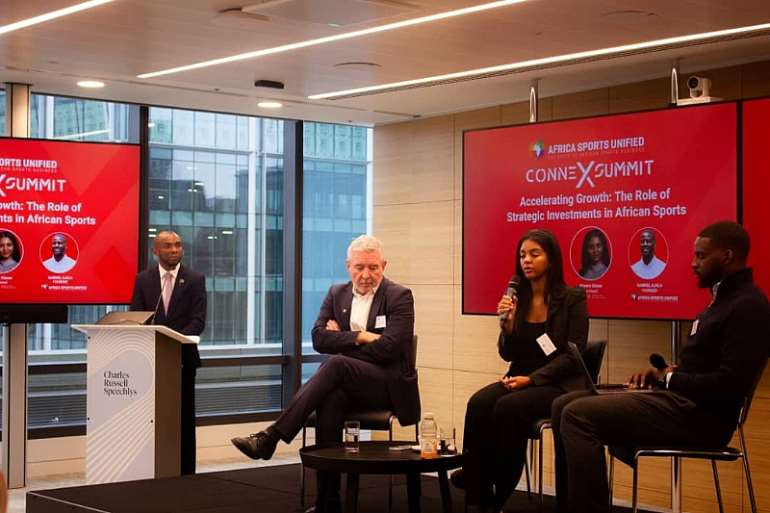
Insights from the ASU Connex Summit 2024 Investment Panel
Africa is often discussed in global sport as a frontier for talent. Increasingly, however, it is becoming something more strategic: an institutional growth market.
At the 2024 ASU Connex Summit, Absera Gizaw of Helios Sports & Entertainment articulated a thesis that reflects a broader structural shift: that Africa's opportunity is not country-specific, but continental in logic. That framing is not aspirational. It is structural.
Africa's population has surpassed 1.5 billion and is projected to reach approximately 2.5 billion by 2050. By mid-century, the continent is expected to account for nearly 40% of the world's youth population. No other region combines demographic expansion with under-penetrated sports commercial infrastructure at this scale.
The question is no longer whether Africa matters in global sport. It is how capital structures itself to participate in its growth.
From Fragmentation to Scale: Why Aggregation Is Becoming Essential
One of the clearest insights from the panel was the importance of a Pan-African lens. Rather than identifying a single "entry country", Helios approaches Africa as a continent-wide ecosystem.
This reflects a structural reality: demand is continental, but delivery remains fragmented.
Commercial structures across African sport are still largely domestic in orientation. Yet demographic projections indicate that Africa will soon represent one of the largest consumer bases in global sport. UNCTAD has repeatedly highlighted structural fragmentation across African markets, reinforcing the need for cross-border aggregation mechanisms.
Sponsors increasingly activate regionally. Digital consumption is increasingly cross-border. Talent flows are continental. But many leagues and rights structures remain nationally siloed.
Aggregation, through pan-African leagues, bundled media rights, shared commercial platforms, and continental sponsorship models, is shifting from a strategic option to a structural requirement.
This is the logic behind investing at scale rather than country-by-country.
Africa as an Institutional Growth Frontier
In mature sports markets such as the United States or Western Europe, institutional structures are fully formed. The "shield"Â of a major league is not investable at entry level. The governance frameworks are established, the valuations mature.
Africa is different.
The formation of NBA Africa, the launch of the Basketball Africa League (now entering its 6th season at the time of writing) and the African Super League (only lasting one season to date), illustrates a shift from participation programmes to institutional platforms.
Similarly, the Confederation of African Football (CAF) reported commercial revenue growth reaching approximately US$125 million in its latest reporting cycle, reflecting expanded broadcast and sponsorship partnerships.
Africa's sports industry is estimated at roughly US$12 billion annually, still modest relative to mature markets, but early in institutional development.
For private capital, this creates a rare window: participation in platform formation rather than secondary asset acquisition.
Africa is not merely a talent source. It is increasingly an institutional build-out opportunity.
Investment Geography: Scale and Strategic Leadership
Investment gravity naturally concentrates in larger economies (Nigeria, South Africa, Egypt, Morocco) where population density, GDP concentration, and infrastructure capacity create commercial logic.
Yet structural scale is not the only determinant.
Rwanda offers a case study in policy-driven ecosystem positioning. Despite its size, Rwanda has hosted Basketball Africa League competitions and staged the 2025 UCI Road World Championships, the first time the event has been held in Africa. Infrastructure investment, coordinated policy, and deliberate IP attraction have repositioned Rwanda as a continental sports destination.
Similarly, the AFCON 2027 host nations (Kenya, Tanzania, and Uganda) are investing heavily in stadium infrastructure as part of tournament readiness programmes. This suggests that ecosystem leadership in African sport is increasingly shaped by strategic coordination, not merely economic size.
For investors, this expands the map.
Perception, Governance and the Confidence Gap
A recurring question in global capital circles concerns governance risk. Yet our panel discussion emphasised that institutional complexity in sport is not uniquely African.
Federations globally operate as political associations rather than purely commercial enterprises. Governance processes in developed markets are frequently protracted and negotiated.
Investor hesitation in Africa often reflects perception asymmetry as much as structural risk. Reputational considerations remain central, but it is evident still how geopolitical narratives can intersect with sports investment environments.
Confidence flows from:
Professional due diligence frameworks
Governance signalling
Credible advisory ecosystems
Demonstrable case studies
Narrative correction requires execution visibility. Capital follows proof.
Talent Systems: Africa's Most Defensible Advantage
Africa has long been recognised as a global exporter of elite athletes. What is evolving is the commercial logic surrounding that talent.
By 2050, Africa will host approximately 40% of the world's children. That represents not only a participation base but a future consumer base. AFCON 2025 generated approximately 6 billion digital views across platforms, demonstrating scale of engagement. The COSAFA Women's Championship includes 11 national teams, signalling growing competitive depth.
The structural opportunity lies not in exporting talent alone, but in strengthening domestic and Pan-African development systems:
Academy infrastructure
Professional league pathways
Media rights monetisation inside Africa
Sponsorship value retained regionally
Institutional partnerships supporting the Basketball Africa League ecosystem further indicate capital interest in development pathways.
The next phase of African sport is not extraction. It is ecosystem construction.
A Continental Thesis
In conclusion, Africa is not a single homogeneous market. It is structurally fragmented, politically diverse, and economically uneven.
But it is unified by demographic trajectory, cultural influence, and underdeveloped institutional capacity.
The opportunity is not in selecting one country. It is in understanding how aggregation, governance evolution, infrastructure alignment, and talent systems interact across the continent.
For global sport, Africa is no longer peripheral. It is formative.
And formative markets reward early conviction.
For governments, rights holders and institutional investors seeking to position sport as a driver of economic growth and capital formation, ASU provides strategic advisory across policy, investment structuring and ecosystem development.
You can watch the clip here from our 2024 ASU Connex Summit
Related Posts