AFCON 2025 Attendance in Context: How Culture, Stadium Dynamics, and Regional Mobility Shaped the Tournament
Judith Macharia
February 27, 2026

Attendance at AFCON 2025 sparked debate, often focused on perceived low turnout & the absence of familiar expressions of fan culture. Grounded in match-level attendance data, the article analyses what the numbers show & highlights ways to strengthen fan attendance & experience at AFCON.
Football occupies a central place in African culture. Matchdays provide moments of gathering, shared identity and experience that extends beyond the ninety minutes on the pitch. The Africa Cup of Nations has long reflected this reality by offering a platform for interaction, regional unity and sustained global and commercial interest from broadcasters, sponsors, and the diaspora community. Each edition draws not only competitive attention but also broader cultural engagement, with fans interacting with the tournament well beyond stadium walls.
AFCON 2025 in Morocco followed this pattern. However, matchday attendance became a focal point of public debate. Much of the discussion centred on visual atmosphere, with claims that the tournament lacked familiar expressions of African fan culture such as coordinated chants and dance. This framing risks undermining both the diversity of cultures across the continent and the context in which the tournament was staged. Fan expression varies widely across regions, and Morocco's hosting approach focused on proper organisation, adequate services, and visitor comfort. Feedback from travelling fans consistently highlighted hospitality, ease of movement within host cities, and a generally welcoming environment among locals.
Given that football is a central part of Morocco's identity, the tournament experience unfolded in everyday local settings and became part of daily discussions, from local cafes in Rabat to the Medina in Fes. These elements formed part of the AFCON 2025 experience, highlighting that stadium attendance alone does not capture the full scope of engagement.
To assess attendance meaningfully, it is necessary that we examine it in context and consider the structural factors that determine fan turnout. When viewed collectively, attendance data from AFCON 2025 does not indicate weak fan engagement. Instead, it reflects the interaction between travel accessibility and cost, infrastructure scale, venue location, and tournament phase. AFCON 2023 in Ivory Coast offers a useful comparison. The 2023 edition benefited from shorter regional travel distances and stronger geographic proximity within Sub-Saharan Africa. Further, smaller stadium sizes, with capacities between 20,000 and 60,000, concentrated crowds more effectively, making attendance appear denser.
The Moroccan edition, by contrast, operated within infrastructure designed for future global events, exposing the challenges of long-term capacity planning. Physical attendance remained constrained by travel affordability and logistical challenges rather than lack of interest. For many African supporters, getting to Morocco required indirect travel routes and higher costs, limiting attendance.
At the same time, AFCON 2025 made deliberate efforts to broaden fan engagement. Tournament organisers and partners invested in fan-focused activities at key entry points, including airports and host cities, fan zones, as well as structured digital engagement. Additionally, CAF and the LOC launched The Yalla Platform, which centralises fan interactions from e-visa applications, ticketing, and real-time tournament information. Royal Air Maroc also supported fan mobility through additional flight capacity and targeted travel packages, including options for diaspora supporters transiting through Casablanca. Orange complemented these efforts through on-ground activations and digital engagement via its Max it App, with the 'Digital Fan Zone,' enabling users to watch matches live, access interviews and summaries, and even create their avatar. These initiatives expanded the tournament's reach but could not fully offset structural travel constraints. Winter scheduling further influenced travel patterns and movement of both the local and visiting fans.
Attendance Patterns Across the Tournament
Match attendance at AFCON 2025 followed a clear progression across tournament stages, shaped by team profiles, venue location, and travel logistics. Morocco staged the competition across several large-capacity stadiums, with more than four group-stage venues exceeding 40,000 seats. In such settings, attendance figures that would appear solid in mid-sized stadiums produced the visual impression of sparsely populated stands. By comparison, matches at AFCON 2023 only had one stadium exceeding 40,000 capacity, allowing similar crowd sizes to appear fuller, despite comparable demand.
Compared with AFCON 2023, the 2025 edition noted some growth in numbers at the group stage (+9%) and quarterfinals (+4%), a slight decline in the round of 16 (-15%), and substantial surges for later-stage matches, including +65% for semifinals, +73% for third place, and +17% for the final.

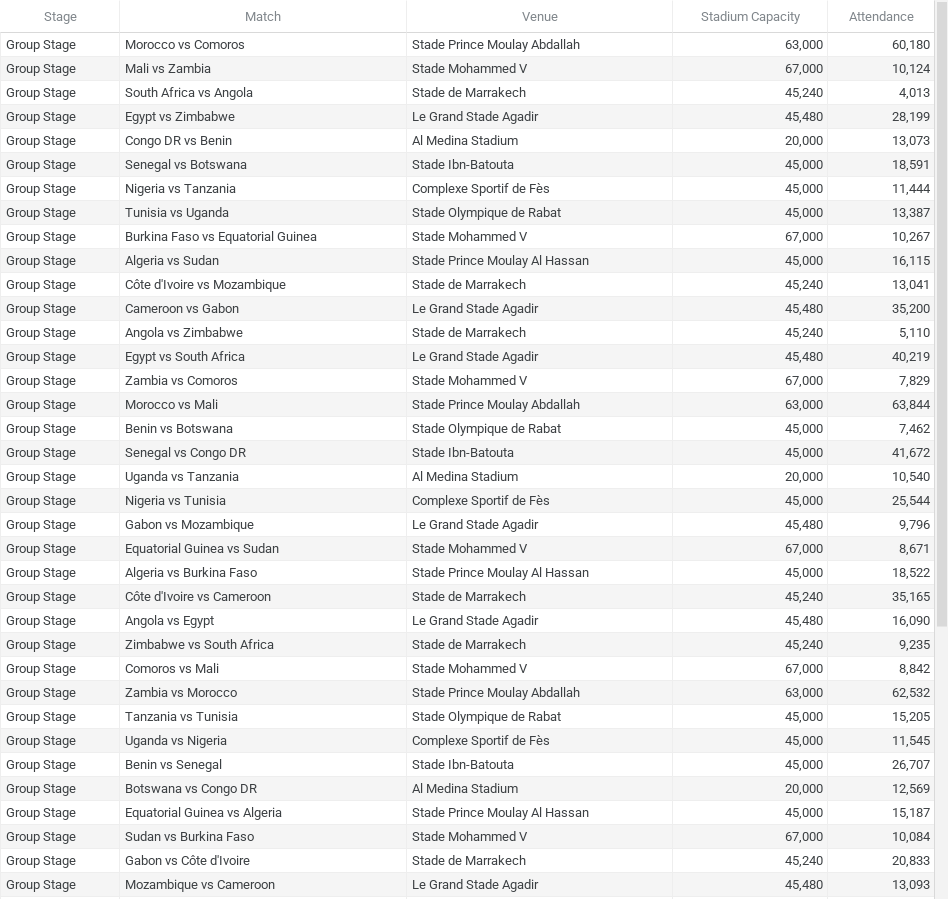
During the group stage, average attendance generally ranged between 10,000 and 15,000 spectators per match, with notable variation across fixtures. Matches involving the host nation recorded the highest turnout. For instance, Morocco vs. Mali at Stade Prince Moulay Abdallah attracted 63,844 spectators, while Morocco vs. Zambia drew 62,532.
Non-host group stage matches also drew substantial crowds. For example, group stage matches at Al Medina Stadium, like DR Congo vs. Benin (13,073) as well as the South Africa vs. Cameroon (14,127) achieved 78% of stadium capacity. Similarly, at Stade de Marrakech, Cote d'Ivoire vs. Cameroon attracted 35,165 fans. In Agadir, Cameroon vs. Gabon attracted 35,200 fans while Egypt vs. South Africa had an attendance of 40,219 fans. This pattern was also identified at Stade Ibn-Batouta, where Benin vs.Senegal (26,707) and Senegal vs. Congo DR(41,672) recorded above-average attendance. This reflected that strong turnouts were not limited to host-nation matches.
Other neutral fixtures recorded more modest attendance, often between 4,000 and 15,000. Examples include Uganda vs Tanzania Al Medina Stadium(10,540) and Burkina Faso vs. Equatorial Guinea at Stade Mohammed V(10,267). Several matches at Stade Mohammed V had an attendance of around 8,000 to 10,000 fans. These figures align with historical group-stage patterns and are similar to AFCON 2023 group stage matches such as Nigeria vs. Equatorial Guinea(8,500), and Senegal vs. The Gambia (7,896). Egypt vs. Mozambique (11,933).
Venue location had a strong impact on attendance. Matches in major urban centres such as Rabat, Casablanca, Tangier, and Marrakech consistently drew larger crowds than those in more geographically isolated cities, particularly for high profile matches. Fes, which hosted several high-profile matches including Nigeria's group games, is several hours by road from Morocco's main population centres. Night kick-off times compounded this challenge by limiting same-day travel options for local supporters. This constraint was reflected in the attendance figures for the matches, such as Nigeria vs. Tanzania (11,444) and Nigeria vs. Tunisia (25,544).
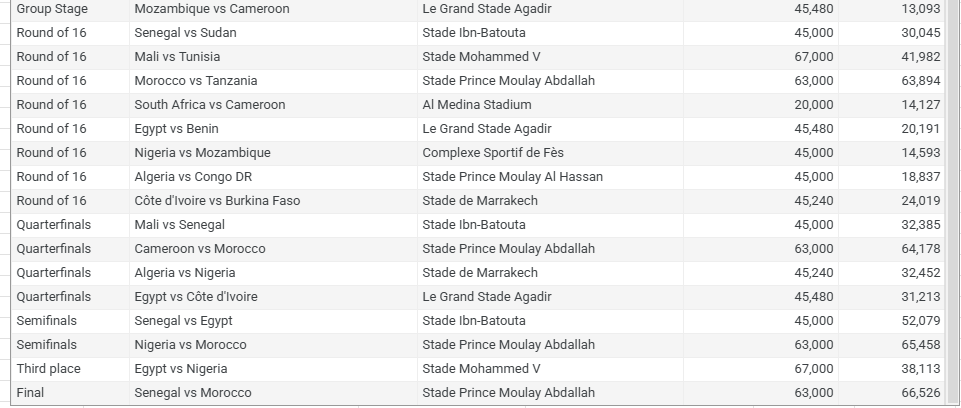
Attendance increased noticeably as the tournament progressed. Round of 16 fixtures regularly attracted between 25,000 and 35,000 spectators, with several surpassing 40,000. Examples include Senegal vs DR Congo (41,672), Senegal vs Sudan (30,045), and Mali Vs Tunisia (41,982). By the quarterfinal and semifinal stages, attendance frequently exceeded 30,000. For example Mali vs Senegal attracted 32,385 fans while Cameroon vs. Morocco had a turnout of 64,178 spectators. In proportional terms, group-stage occupancy averaged between 25 and 40 per cent, rising to approximately 50-70 per cent during the knockout rounds. This progression closely mirrors patterns observed at AFCON 2023 culminating in semifinals and finals with attendance exceeding 50,000.
Overall, the data shows that attendance in Morocco followed expected trends for a major tournament despite the challenges. It also reflects the importance of embracing Africa's cultural diversity as a defining element of the AFCON experience. At the end of it all, improving matchday attendance is closely tied to how easily fans can move across borders within Africa. The African Continental Free Trade Area (AfCFTA) provides a pathway to address this challenge if effectively implemented and operationalized at the national level. Simplified visa processes, lower air travel costs and improved regional transport connectivity, would reduce the barriers that currently limit cross-border fan travel. Over time, integrating AFCON planning with AfCFTA mobility frameworks could help convert widespread interest into more consistent physical attendance.

Judith Macharia
Research and Content Lead, Africa Sports Unified
Related Posts